
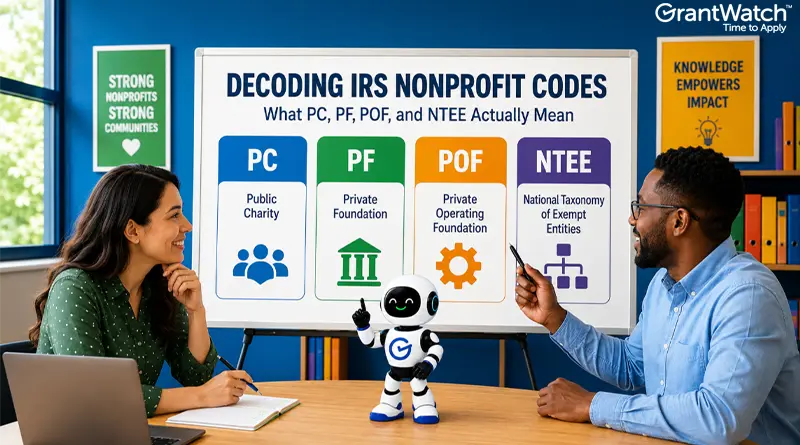
Decoding IRS Nonprofit Codes: What PC, PF, POF, and NTEE Actually Mean
Are you lost when it comes to PC, PF, POF, and NTEE? Most nonprofit professionals know what a 501(c)(3) is. Far fewer know what happens after that classification. Why is one organization labeled PC, another PF, and another POF? These codes appear in grant directories, donor research platforms, foundation databases, and nonprofit records every day. Yet they’re rarely explained in plain language.
Using the IRS’s own current data covering 1.4 million organizations, this article breaks down what each code means, why it matters for grant research, and how it differs from an entirely separate system, NTEE, that gets confused with it constantly. In plain language: PC, PF, and POF codes describe an organization’s tax and foundation classification. NTEE codes describe its primary mission or activity. Neither system, by itself, tells you whether an organization gives grants, seeks grants, receives grants, or performs several of those roles at once.
Key Insight: An organization’s IRS classification and mission classification do not determine whether it is a grantmaker, grantseeker, or grant recipient. Those are separate dimensions.
GrantWatch’s analysis found that 87.6% of the organizations in the June 9, 2026 Publication 78 file were classified as public charities. That single figure explains a lot of what follows.
Key Takeaways
- Publication 78 lists 1,435,544 organizations the IRS recognizes as eligible for tax-deductible contributions.
- Roughly 88% are classified as public charities (PC).
- PF and POF, the private foundation codes, are not the entire universe of grantmakers.
- NTEE codes classify an organization’s mission, not its tax status.
- Many active grantmaking organizations are classified as public charities, not private foundations.
- IRS data alone cannot identify every organization currently acting as a grantmaker.
Why These Codes Matter
These classifications affect more than paperwork.
They affect donor deduction limits, since how much of a contribution is tax-deductible depends on the recipient organization’s classification. They also influence foundation regulation, as private foundations face different oversight and payout rules than public charities.
These classifications are equally important for grant research. A search that only looks for organizations coded as private foundations will miss a large number of active grantmakers.
That last point trips up a lot of people doing funder research. A grant researcher looking for foundation funders might assume every grantmaker shows up in the data as a PF or POF. In reality, many grantmakers, including community foundations and certain corporate giving programs, are classified as public charities instead.
Where These Codes Come From
The IRS maintains a public dataset called Publication 78, officially the Cumulative List of organizations described in Section 170(c) of the Internal Revenue Code. It lists organizations the IRS recognizes in its searchable data as eligible to receive tax-deductible charitable contributions.
Some eligible recipients, including certain churches, government units, and group ruling subordinates, may not appear in the file the same way, even though contributions to them are still deductible. Publication 78 is best treated as the IRS’s searchable list, not an absolute universe of every eligible organization.
One additional caveat: it lists organizations only under their legal name on file with the IRS. A nonprofit operating under a “doing business as” name won’t show up under that name, only its official registered name will.
The Codes, Explained
Almost every code in Publication 78 falls under the same section of the tax code, 501(c)(3), the section most people mean when they say “nonprofit.”
What differs between the codes isn’t tax-exempt status itself. It’s the foundation classification underneath it, which affects how much of a donation is tax-deductible and how much oversight the organization is subject to.
| IRS Code | Classification | Organizations | Share of File |
| PC | Public charity | 1,258,055 | 87.6% |
| PF | Private foundation | 123,302 | 8.6% |
| POF | Private operating foundation | 9,460 | 0.7% |
| PF + POF | Combined private foundations | 132,762 | 9.2% |
Beyond these, supporting organizations (coded SO or SOUNK depending on how specifically their type has been determined) together make up about 1.5% of the file.
A handful of smaller categories, EO, EO,LODGE, GROUP, and FORGN, round out the rest, together well under 2% of the total. A small number of organizations also carry combination codes, for example, an organization that is both foreign-addressed and a private foundation, which is why individual category counts don’t sum to a perfectly even total on their own.
Source and methodology: GrantWatch analyzed the IRS Publication 78 bulk data file downloaded June 9, 2026. Counts include combination codes and reflect the file as published on that date. This analysis will be updated as new IRS releases become available.
| Classification | Answers |
| PC, PF, POF | What is the organization’s tax and foundation status? |
| NTEE | What does the organization actually do? |
Why “Public Charity” Doesn’t Mean “Not a Funder”
It’s tempting to assume public charities only receive grants, while private foundations are the ones that give them. That’s not accurate.
Community foundations, federated giving programs, public grantmaking charities, and certain corporate giving programs may all be classified as public charities even when grantmaking is a major part of what they do. The PC code describes tax status, not whether an organization gives money, receives it, or both.
Publication 78 doesn’t separately report how many of its 1,258,055 public charities are active grantmakers versus organizations that only receive funding.
Why “Built on 990 Data” Isn’t the Full Picture
Plenty of nonprofit and grant research tools market themselves as being “built on 990 data.” That’s a real technical achievement, parsing hundreds of thousands of tax filings into a searchable database is genuine engineering work. But it’s also, on its own, just automated extraction of whatever the IRS filing already contains. It doesn’t fix the underlying gaps in the filings themselves.
Those gaps are real: organizations filing the abbreviated 990-N disclose no financial detail at all, some organizations report their total giving as a lump sum instead of itemized grants, and IRS processing can lag behind an organization’s actual current activity. A platform can parse a 990 flawlessly and still inherit every one of those gaps, because the gap isn’t in the parsing, it’s in what the filing was ever able to capture in the first place.
Closing that gap takes something parsing alone can’t do: a way for the organization itself to confirm what it actually does. GrantWatch pairs that self-identification with human review before a submission goes live, which is part of what supports deep discovery of funders that automated 990 parsing alone would miss entirely. Automated data extraction and human-confirmed self-identification are solving two different problems, and a platform that only does the first is still working from the same incomplete filing everyone else is.
IRS records establish legal and tax classifications, but they don’t always reveal an organization’s current role in the funding ecosystem. GrantWatch supplements IRS data with information submitted through claimed and verified organization profiles. Organizations can identify themselves as grantmakers, grantseekers, grant recipients, or more than one, while updating the subject areas that describe their work.
Why 990 Data Alone Is Not Enough
As of June 2026, the GrantWatch Foundation Directory contains 374,397 funder profiles. It draws from IRS Form 990 data and information supplied directly by organizations. This additional layer helps identify grantmaking activity that Publication 78 classifications alone cannot reveal.
There are likely many more active funders than current IRS data alone reflects. Smaller organizations that file the abbreviated 990-N disclose no financial detail at all. Even organizations that do file a full 990 sometimes report their total giving as a single lump sum rather than itemizing individual grants, so that giving activity may not be parsed out as identifiable grants in the data.
Self-identification is one way this gap gets closed. An organization that claims and verifies its profile can confirm its own role directly, rather than relying on tax filings alone to establish it.
Common Misconception
Myth: Public charities receive grants while private foundations give grants.
Reality: The classification describes tax status, not whether an organization gives grants, receives grants, or both. Community foundations and other grantmakers are frequently classified as public charities.
IRS Classification vs. Mission Classification
IRS classifications such as PC, PF, and POF describe an organization’s tax and foundation status. They don’t describe its program area.
A public charity could be a food bank, a hospital, a museum, a school, an environmental group, or a grantmaker. The code alone won’t tell you which. That’s why nonprofit research systems often use a second layer of categorization, built around mission and activity rather than legal structure.
So, what is NTEE?
NTEE, the National Taxonomy of Exempt Entities, is a separate mission-based classification system used in nonprofit data, including the IRS Exempt Organizations Business Master File. It was developed by the National Center for Charitable Statistics (NCCS).
NTEE uses a letter for an organization’s broad category (A for Arts, B for Education, E for Health) followed by numbers that narrow it down, for example B20 for elementary and secondary education.
NTEE data doesn’t appear in Publication 78 at all, since Pub 78 only contains six fields per organization: EIN, name, city, state, country, and deductibility code. According to NCCS, the system is not perfectly precise, since many nonprofit missionscross multiple categories.
| Code Type | Purpose |
| Publication 78 codes | Deductibility and foundation status |
| NTEE codes | Mission and activity classification |
Example: GrantWatch groups organizations and grants into 61 subject areas. This lets users search by mission, while IRS classifications indicate legal and tax status. Before an organization claims its profile, its categories are approximated from available data. Once claimed and verified, the organization can update them directly.
This Isn’t Just for Organizations Seeking Grants
The classifications discussed above matter to organizations seeking funding, foundation staff, corporate giving teams, and philanthropic advisors.
For these professionals, the question goes beyond which grants are currently open. It involves due diligence: Is the organization legitimate and active? What has it funded or received in the past? And does its classification affect how a grant or gift must be structured?
Classification can directly affect compliance requirements. For example, a private foundation granting to another private foundation may face different requirements, such as expenditure responsibility, than one granting to a public charity. Knowing whether a prospective partner is classified as PC, PF, or POF can therefore affect the paperwork and oversight involved. Organizations should consult their own legal or financial advisors regarding specific compliance requirements.
Giving history is equally important. Funders and advisors evaluating potential partners may want to know what an organization has previously received, from whom, and over what period. GrantWatch’s Foundation Directory and Grant Recipient Search support this type of research, helping users identify and evaluate foundations, public charities, and corporate giving programs beyond simply finding open grants.
Raw IRS data alone does not provide this full picture. Publication 78 lists 1,435,544 organizations by tax classification, but does not distinguish whether they are grantmakers, grant recipients, or both. A donor-focused database can add valuable context by separating funders from recipients, incorporating multi-year giving history, supplementing automated 990 data with human review, and organizing organizations by mission rather than legal status.
Frequently Asked Questions
Is a PC organization a 501(c)(3)?
Yes. PC stands for public charity and is a classification within the 501(c)(3) framework.
Does a PC code mean an organization does not make grants?
No. PC means the organization is classified as a public charity. It does not indicate whether the organization makes grants, receives grants, or does both.
What’s the difference between PF and POF?
Both are private foundations. A private operating foundation (POF) primarily conducts its own charitable activities, while a private foundation (PF) typically funds the activities of others.
Can a public charity make grants?
Yes. Many community foundations and other grantmaking organizations are classified as public charities.
Are all grantmakers private foundations?
No. Many grantmakers are classified as public charities. Government agencies and corporate giving programs operated directly by taxable businesses generally fall outside Publication 78, while separately incorporated corporate foundations may appear as private foundations.
The Bottom Line
IRS deductibility codes and NTEE codes answer different questions. PC, PF, and POF describe tax and foundation classification. NTEE describes mission or activity. Neither one fully describes an organization’s role as a grantmaker, grantseeker, or grant recipient. For funder research, private foundations are an important starting point, but they are not the entire grantmaking universe. The practical lesson is simple: never use an organization’s IRS classification as a substitute for researching what the organization actually does.
Is your organization listed here? Organizations can claim and verify their GrantWatch profile to confirm their own role as a grantmaker, grantseeker, or recipient. If an organization can’t be found in the directory yet, it can still create and claim a profile directly, attaching an IRS determination letter to verify its tax-exempt status. Claiming and completing a profile also earns a GrantWatch Visibility Tier™ and complimentary GWI Tokens for GrantWatch Intelligence™, GrantWatch’s conversational search tool for funders, grant recipients, and IRS Form 990 data.
About GrantWatch
A trusted resource since 2010. For more than 16 years, GrantWatch has helped nonprofits, small businesses, schools, government agencies, and individuals discover funding opportunities and navigate the grant process with confidence. Thousands of organizations rely on GrantWatch’s extensive database of verified grants and funding resources to identify opportunities and secure support for meaningful projects.
Today, GrantWatch supports organizations throughout the full grant lifecycle through a single, streamlined platform. In addition to access to more than 11,000 active, verified, and human-curated grant opportunities, the platform includes a centralized Dashboard that serves as the command center for the GrantWatch Full Grant Lifecycle Platform, giving users a centralized view of opportunities, deadlines, research, and workflow activity across the 12-stage Grant Pipeline. Users also benefit from integrated tools including the AI Grant Finder, AI Grant Writing Tool, My Grant Calendar, Grant Alerts, Foundation Search, and Awarded Grant Search, helping move funding efforts from discovery to award and measurable impact.
GrantWatch, founded by Libby Hikind, is the author of The Queen of Grants series, including The Queen of Grants series: The Queen of Grants: From Teacher to Grant Writer to CEO and The Queen of Grants 2: GrantTalk Secrets for the New Era of Writing. Drawing on decades of experience in the grants industry, GrantWatch was created to simplify how organizations discover, evaluate, and pursue funding.
