
The Grant Profession Has Changed: What Modern Grant Management Software Should Include
How GrantWatch brings it all together
By Libby Hikind, Founder and CEO of GrantWatch.com
Grant professionals have historically needed five or six separate tools to do one job. A database to find grants. A second tool to research foundations. A third for IRS Form 990 data. A fourth for project tracking. A fifth, increasingly, for AI-assisted research. Each tool works on its own. Together, they create duplicate data entry, disconnected records, and hours lost moving information between systems instead of pursuing funding.
GrantWatch has spent 16 years evolving alongside what funders, donors, grant seekers, and grant recipients actually need. No version of the platform has ever been treated as finished. That continuity made it possible to bring grant discovery, foundation research, AI-assisted matching, pipeline management, and live human support together in one connected ecosystem.
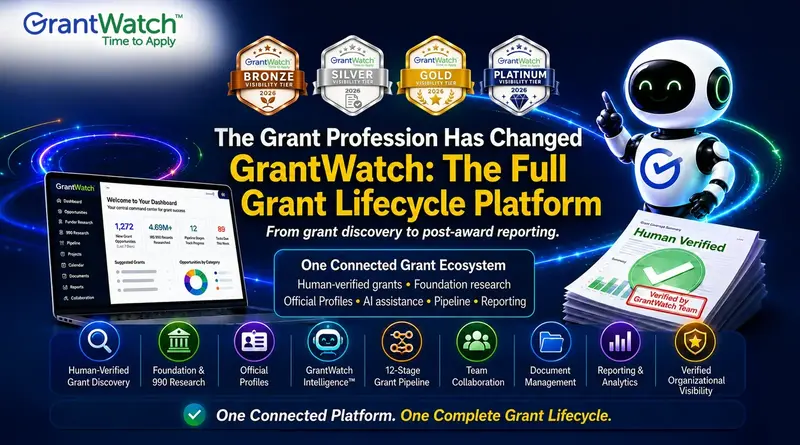
Today, GrantWatch is a Grant Lifecycle Platform. It connects grant discovery, foundation research, AI-powered assistance, collaboration, and post-award management in one connected ecosystem.
How Modern Grant Platforms Have Evolved
Early grant software solved one problem: finding grants. A user searched a database, read a listing, and moved on to apply somewhere else entirely for foundation research, project tracking, and reporting.
Later platforms began adding foundation research, workflow management, and proposal support on top of that base search function. Grant seekers still often needed to combine two or three products to cover the full funding lifecycle.
Today, organizations increasingly expect a single, connected platform. One that supports the entire funding lifecycle, from initial discovery through post-award reporting, without switching between disconnected tools. That shift, toward unified workflows instead of a collection of single-purpose products, is the standard modern grant management software is now being built to meet.
Below is what that standard should include, and specifically what GrantWatch now provides at each stage.
GrantWatch by the Numbers
As of this writing, GrantWatch’s database includes more than 374,000 funder profiles and 2.2 million grant recipient profiles, drawn from 4.69 million IRS Form 990 records. More than 63,000 total grants are tracked across active and archived listings, representing over $2.26 trillion in funded grants, based on the grant recipient records in the GrantWatch database as of July 2026. New grants are added daily and expired listings are archived the same day, so these figures shift constantly by design. They are a snapshot, not a static claim.
The platform continues to evolve every week. As new organizations claim profiles, new grants are verified, and additional foundation and recipient records are connected, the ecosystem becomes richer and more useful for every participant.
Grant Discovery: Human Verified, Not Just Aggregated
GrantWatch’s research team reviews and verifies every grant listing before publication. Funders can also submit their own opportunities directly to GrantWatch. Every funder-submitted listing still goes through the same human research and verification process before it goes live. Either way a listing originates, a person on GrantWatch’s team confirms it is accurate, current, and complete before it reaches a search result.
That distinction matters for accuracy. Human review catches expired, duplicate, or misclassified listings before they ever reach a search result. While AI accelerates research and drafting elsewhere on the platform, GrantWatch continues to rely on human verification for grant listings themselves, helping reduce expired, duplicate, and inaccurate opportunities before they reach users. GrantWatch’s database spans federal, state, local, foundation, and corporate grants across every major applicant type: nonprofits, small businesses, government agencies, tribal nations, schools, healthcare organizations, researchers, libraries, artists, and individuals. Business grants and government grants sit alongside nonprofit and foundation funding as core, fully-supported categories.
Personalized Matching: GrantWatch Intelligence™ (GWI)
GrantWatch Intelligence™ powers two tiers of grant matching from a user’s Dashboard:
- Baseline Match: for users who have not claimed an organizational profile, GWI filters the dashboard feed using manually selected location, category, and applicant-type preferences.
- Premium Match: for users with a claimed profile, GWI reads the organization’s mission, program descriptions, and stated goals as unstructured text. It layers that context on top of stated preferences to surface more targeted matches.
The more organizations claim and complete profiles, the more context GWI has to work with. A grant recipient’s Official Profile feeds directly into GWI’s matching, so the same profile that establishes an organization’s credibility also becomes the input GWI uses to find it better funding. Matching quality is expected to improve as profile adoption grows. See adoption data below.
Foundation and IRS Form 990 Research, in the Same Interface as Live Deadlines
GrantWatch’s Foundation Directory cross-references IRS Form 990 records alongside active grant listings. A user researching a funder’s giving pattern does not need to leave the platform to check whether that funder has an open, live deadline right now. That side-by-side view, historical funder behavior next to an active application window, is the practical value of housing both in one place.
We track this data starting in 2015, integrated directly with active listings. A funder’s recent giving pattern and their currently open deadline are one click apart instead of two separate searches. Each foundation profile also links directly to the grant recipients it has funded, so a funder’s giving history and the organizations it supports stay connected rather than living in separate records. Donor-advised funds are part of this picture too. Any DAF with its own EIN can claim and complete a GrantWatch profile the same way any other organization does. A number of DAFs list active grants directly on the platform as funders in their own right, not just as a line item inside a sponsor’s tax filing.
GrantWatch Intelligence™ as a Research Assistant
Beyond matching, GWI functions as a conversational research tool. It is grounded in GrantWatch’s own verified data: grant listings, 990 filings, recipient history, and organizational profiles, rather than open-web AI search. Users ask natural-language questions to find funders, understand giving patterns, or draft early proposal language. Responses are sourced from the underlying database rather than general internet content. Grants GWI surfaces are the same listings that live in the Pipeline, so research and tracking draw from one connected database rather than separate systems.
From Research to Submission: The Grant Pipeline
GrantWatch’s Grant Pipeline is a Kanban-style board tracking opportunities through customizable stages: interest, eligibility review, calendar, writing and collaboration, internal review, final submission, submitted, denied, awarded, implementation, reporting, and post-award. Teams see what is in progress, what is overdue, who is assigned, and what is missing at a glance, all in one visual workflow built specifically for grants.
Every GrantWatch account has a persistent account number, visible in the bottom-left of the dashboard menu. To bring someone onto a specific grant, enter their account number directly on that grant’s task card. They receive a notification in their own dashboard. Once accepted, they are on the team for that grant. There is no separate invite process, no email chains, and no per-seat charge for anyone already inside the GrantWatch ecosystem, including board members, volunteer grant writers, and outside consultants. Organizations that want to bring a whole team onto GrantWatch together, for example a university’s faculty and finance staff or a school district’s instructional leaders across buildings, can do so through a discounted multi-user subscription at the organizational level. That subscription is what brings a team into the GrantWatch ecosystem in the first place. Once they are in, collaborating on any grant is free, with no per-seat charge.
Relationship Management, Not Just Grant Tracking
Modern grant management extends beyond the grants themselves. Winning and managing funding depends on the people involved just as much as the paperwork. Organizations need to track relationships with funders, collaborators, consultants, board members, and internal staff throughout the entire grant lifecycle, not just at application time. GrantWatch designed its Pipeline and account system around that reality. Every grant carries its own team, assigned contacts, and history of who did what and when, keeping relationship context tied directly to the grant.
Live Human Support
GrantWatch offers live phone and email support from real grant specialists.That direct access matters most when teams face unexpected challenges: a funder moves up a deadline, someone raises a matching question at 4 p.m. on a Friday, or a new user needs a five-minute walkthrough instead of a help article. For organizations without dedicated grants staff, a volunteer treasurer or a single part-time development coordinator, that live human line is often the difference between a missed opportunity and a submitted application.
One Connected Ecosystem, Unlocked by MemberPlus+
Every grant listing on GrantWatch links directly to the funder’s profile. Every funder profile links back to that funder’s open grants. A user can move from “here’s a grant that fits” to “here’s everything else this funder has funded and cares about” in one click, in either direction. Full access to that connected view is a MemberPlus+ subscriber benefit. It is the single feature that makes the rest of the ecosystem, the Foundation Directory, GWI matching, and the Pipeline, work together as one system instead of a set of disconnected lookups.
How the Ecosystem Connects
Every part of GrantWatch feeds the next. A grant seeker’s Official Profile feeds GrantWatch Intelligence. GWI surfaces grant opportunities.
- Each opportunity connects to a foundation profile.
- Each foundation profile connects to its IRS 990 record.
- Each foundation profile also connects to the grant recipients it has funded.
- Each recipient’s own Official Profile feeds back into GWI.
Matched grants move into the Pipeline. The Pipeline carries a grant through to reporting. No step lives in isolation from the rest.
Deadline Tracking and Daily Database Maintenance
GrantWatch adds new grants to the database daily. The platform archives expired listings on the same day their deadlines pass, so an organization’s active dashboard does not accumulate stale opportunities. Users can also set custom alerts on individual grants or categories.
Official GrantWatch Profiles and Visibility Tiers™
Organizations can now claim an Official GrantWatch Profile. This adds verified mission statements, program details, and organizational metrics in place of a thin, auto-generated listing. Completed and verified profiles earn Bronze, Silver, Gold, or Platinum Visibility Tiers™. Each tier unlocks a complimentary allotment of GrantWatch Intelligence™ tokens.
Funders can claim and complete an Official Profile too, and earn the same Bronze through Platinum tiers. This is entirely independent of whether that funder has ever listed a grant on GrantWatch. A funder profile is its own path. Complete it, earn a tier, and build a visible, credentialed presence on the platform on its own terms.
Funders who list a grant have additional ways to be gain visibility. GrantWatch’s research team reviews and verifies every submitted grant before publication, and GrantTalk may also feature the grant. Funders can also browse nonprofit applicants who have claimed their own 2026 Official Profile, giving funders a direct view into the organizations most actively engaged on the platform.
Early adoption: the response to Official GrantWatch Profiles since launch has been overwhelming. New organizations are claiming and completing their profile every day. As adoption grows, GrantWatch Intelligence™ gains more organizational context to work with, and the entire ecosystem gets sharper for everyone using it.
A note on tokens: complimentary tokens earned through Visibility Tiers or a new-subscriber welcome bonus are active-subscription perks. They are forfeited if a subscription is canceled. Tokens purchased directly in a Token Pack are permanent. They remain in an account’s Token Vault™ indefinitely, even through a cancellation and later reactivation.
Token Pricing for Scaled Research
New MemberPlus+ subscribers receive a one-time welcome bonus of GWI tokens. The goal is to get organizations searching well from day one, giving them room to practice good search habits with GrantWatch Intelligence before they need to rely on it for a real deadline. Additional tokens are available with no recurring fees or overage charges:
| Token Pack | Price | Approximate Deep Analyses |
|---|---|---|
| 1,000,000 tokens | $12 one-time | ~50 |
| 5,000,000 tokens | $55 one-time | ~250 |
| 10,000,000 tokens | $95 one-time | ~500 |
A MemberPlus+ subscription starts at $22 a week, or as little as $249 a year on the annual plan. Every plan, weekly, monthly, quarterly, or annual, includes the exact same platform. Grant search, the Foundation Directory, GrantWatch Intelligence, the Grant Pipeline, team collaboration, AI grant writing, award management, and reporting are not locked behind a higher tier. There is no separate, more expensive plan required to unlock the full platform. The only thing that changes between plans is the welcome bonus of GWI tokens included with a first subscription.
Who This Is Built For
Nonprofits, colleges and universities, sponsored research and research administration offices, K-12 school districts and charter schools, public and academic libraries, federal, state, county, municipal, and tribal governments, healthcare organizations and hospitals, research institutes, community and corporate foundations, and economic development organizations all run a similar core workflow. Find funding. Research the funder. Write the proposal. Track the deadline. Report on the award. GrantWatch is built around that shared workflow rather than any single sector.
GrantWatch access is also available through a number of public, university, and state library systems. This extends research access to individuals and organizations who might not otherwise have a paid subscription.
The Future of Grant Management Software
The next phase of grant management software is already taking shape. A few directions stand out.
AI is becoming a research and drafting assistant, not a replacement for the people doing the work. The organizations that benefit most treat AI as a way to move faster through research and first drafts, while judgment, relationships, and final decisions stay with people.
Verified organizational identity is becoming standard. A claimed, verified profile, not an anonymous listing, is becoming the baseline expectation for both grant seekers and funders who want to be found and trusted.
Personalized recommendations are replacing generic keyword search. Matching based on an organization’s actual mission and program history produces better results than a static filter list alone.
Integrated workflows are replacing single-purpose tools. Discovery, research, collaboration, and reporting are converging into one connected system rather than staying spread across five.
Trusted, verified data is becoming more valuable than open web search. As general AI search tools pull from the open web, human-verified, purpose-built data sources are becoming the more reliable foundation for decisions that involve real funding.
One Platform, Built to Do It All
Human-verified grant discovery. Foundation and IRS Form 990 research integrated with live deadlines. An AI research assistant grounded in real, verified data. A visual pipeline that costs nothing extra to collaborate on. Official Profiles that make an organization’s own story an active part of how funding finds them. Live human support from real specialists. Business, government, nonprofit, and foundation funding, all in one place.
Grant professionals used to accept that no single platform could do all of this well. GrantWatch was built on the belief that they should not have to accept that anymore.
Frequently Asked Questions
Is GrantWatch still a grant listing database, or something more now?
It is both. Human verified grant discovery remains the foundation of the platform. Foundation research, IRS 990 analysis, AI-assisted matching, and pipeline management have been added on top of that foundation.
How far back does GrantWatch’s foundation giving data go?
GrantWatch’s Foundation Directory tracks giving and award history starting in 2015, integrated directly with live, active grant listings. A funder’s recent pattern and their currently open deadline are always one click apart.
How many organizations have claimed a GrantWatch Profile so far?
The response has been overwhelming since launch. New organizations are claiming and completing Official Profiles every day.
Do GrantWatch Intelligence™ tokens expire?
Purchased tokens never expire and remain in an account’s Token Vault™ even after cancellation. Complimentary tokens from Visibility Tiers or a welcome bonus are tied to an active subscription and are forfeited on cancellation.
Does GrantWatch offer live customer support?
Yes. GrantWatch provides live phone and email support from real grant specialists.
Can a donor-advised fund (DAF) have a profile on GrantWatch?
Yes. If the DAF has its own EIN, it can claim and complete a GrantWatch profile the same way any other organization does. A number of DAFs also list active grants directly on the platform as funders.
Can funders claim a profile on GrantWatch?
Funders can claim an Official GrantWatch Profile and earn a Bronze, Silver, Gold, or Platinum Visibility Tier. Funders who list grants may also be featured on GrantTalk and connect with nonprofit applicants.
Why are Official GrantWatch Profiles important?
Official GrantWatch Profiles increase visibility, help showcase missions, improve GrantWatch Intelligence™ matching, and unlock Bronze, Silver, Gold, or Platinum Visibility Tiers with associated benefits.
Why does GrantWatch call itself a Grant Lifecycle Platform instead of a grant database?
GrantWatch provides human verified grant discovery on a large scale. It also connects foundation research, 990 data, Official Profiles, GrantWatch Intelligence™, and more in one platform. The term “Grant Lifecycle Platform” reflects that broader role.
About GrantWatch
A trusted resource since 2010. For more than 16 years, GrantWatch has helped nonprofits, small businesses, schools, government agencies, and individuals discover funding opportunities and navigate the grant process with confidence. Thousands of organizations rely on GrantWatch’s extensive database of verified grants and funding resources to identify opportunities and secure support for meaningful projects.
Today, GrantWatch supports organizations throughout the full grant lifecycle through a single, streamlined platform. In addition to access to more than 11,000 active, verified, and human-curated grant opportunities, the platform includes a centralized Dashboard that serves as the command center for the GrantWatch Full Grant Lifecycle Platform, giving users a centralized view of opportunities, deadlines, research, and workflow activity across the 12-stage Grant Pipeline. Users also benefit from integrated tools including the AI Grant Finder, AI Grant Writing Tool, My Grant Calendar, Grant Alerts, Foundation Search, and Awarded Grant Search, helping move funding efforts from discovery to award and measurable impact.
GrantWatch, founded by Libby Hikind, is the author of The Queen of Grants series, including The Queen of Grants series: The Queen of Grants: From Teacher to Grant Writer to CEO and The Queen of Grants 2: GrantTalk Secrets for the New Era of Writing. Drawing on decades of experience in the grants industry, GrantWatch was created to simplify how organizations discover, evaluate, and pursue funding.
